
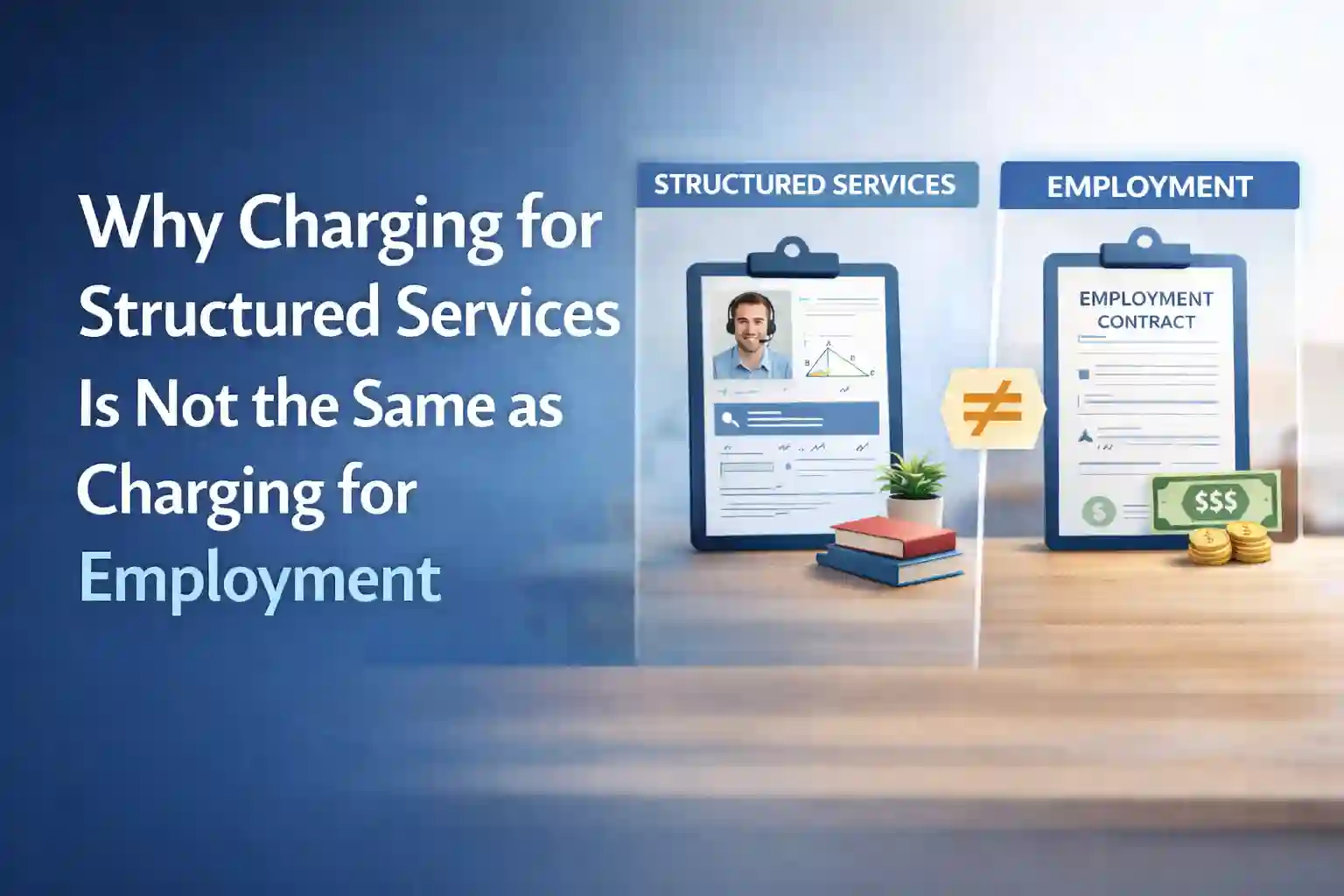
Why Charging for Structured Services Is Not the Same as Charging for Employment
A Structural and Economic Clarification from Beacon Tutors
Executive Overview
Beacon Tutors operates as a structured digital tutoring marketplace, not as a traditional employment agency. A common misunderstanding arises when structured service fees or registration fees are interpreted as payments for employment. This interpretation is economically and structurally incorrect.
Charging for structured services means funding infrastructure. Charging for employment would mean selling guaranteed income. These two models are fundamentally different. This article clarifies the distinction using marketplace economics and global platform standards.
The Structural Definition of Employment
Traditional employment involves:
-
A contractual salary or wage
-
Employer control over working hours
-
Supervision and performance management
-
Income stability independent of market demand
-
Legal employer obligations
In employment, the employer assumes demand risk and guarantees compensation regardless of short-term fluctuations. Charging for employment would imply that a company is selling a salaried position or guaranteeing placement. Beacon Tutors does not operate under this model.
The Structural Definition of Marketplace Services
Marketplace services operate under a different economic structure. Beacon Tutors provides:
-
Access to verified student demand
-
Requirement-driven visibility systems
-
Structured shortlisting frameworks
-
Secure communication channels
-
Payment integrity mechanisms
-
Governance and compliance oversight
These are structured services. They enable opportunity access. They do not guarantee income. Charging for structured services means contributing to the infrastructure that enables professional participation.
Real-World Marketplace Comparisons
Across industries, professional marketplaces charge for structured services without offering employment.
Freelance platforms charge service fees or subscription tiers to fund escrow systems and client acquisition. E-commerce platforms charge seller onboarding and listing fees to maintain logistics, transaction security, and marketplace visibility. Professional networking platforms charge premium access fees for structured exposure and infrastructure benefits.
In none of these cases are participants purchasing employment. They are contributing to the infrastructure that supports opportunity access. Beacon Tutors follows the same globally recognized model.
The Economic Logic of Infrastructure Funding
Infrastructure requires:
-
Technology development
-
Platform maintenance
-
Student acquisition campaigns
-
Compliance systems
-
Security protocols
-
Administrative oversight
These costs exist regardless of individual tutor success. Structured fees distribute infrastructure costs across participants who benefit from the system. This is an economic sustainability model — not an employment contract.
Why Employment and Marketplace Access Must Not Be Confused
Confusion arises when marketplace participation is viewed through an employment lens.
Employment implies:
-
Guaranteed income
-
Employer liability for work volume
-
Centralized operational control
Marketplace participation implies:
-
Independent professional status
-
Income dependent on demand alignment
-
Flexible engagement
-
Performance-driven opportunity
Beacon Tutors provides structured access, not salary guarantees. Charging for infrastructure access is not equivalent to selling jobs.
The Role of Professional Commitment
Structured service fees also serve as a commitment filter. Without disciplined participation:
-
Non-serious registrations increase
-
Database quality declines
-
Matching efficiency weakens
-
Platform sustainability is compromised
Professional marketplaces require structured onboarding to preserve quality and seriousness. Beacon Tutors maintains this discipline to protect ecosystem integrity.
Sustainability and Long-Term Platform Stability
Charging for structured services ensures:
-
Continuous technology upgrades
-
Ongoing demand generation
-
Platform scalability
-
Compliance enforcement
-
Secure transaction systems
If infrastructure were funded without structured contribution, long-term stability would weaken. Professional ecosystems require sustainable financial models. Beacon Tutors operates under this disciplined governance principle.
Conclusion
Charging for structured services at Beacon Tutors is not the same as charging for employment. Employment guarantees salary under centralized control. Marketplace services provide infrastructure that enables independent opportunity access.
The Registration Fee and related structured charges fund:
-
Demand acquisition
-
Platform development
-
Governance systems
-
Compliance oversight
-
Secure operational infrastructure
Beacon Tutors is not selling jobs. It is sustaining a professional, secure, and scalable tutoring marketplace. Infrastructure enables opportunity. Structured funding sustains infrastructure. Sustainability protects both tutors and students.