
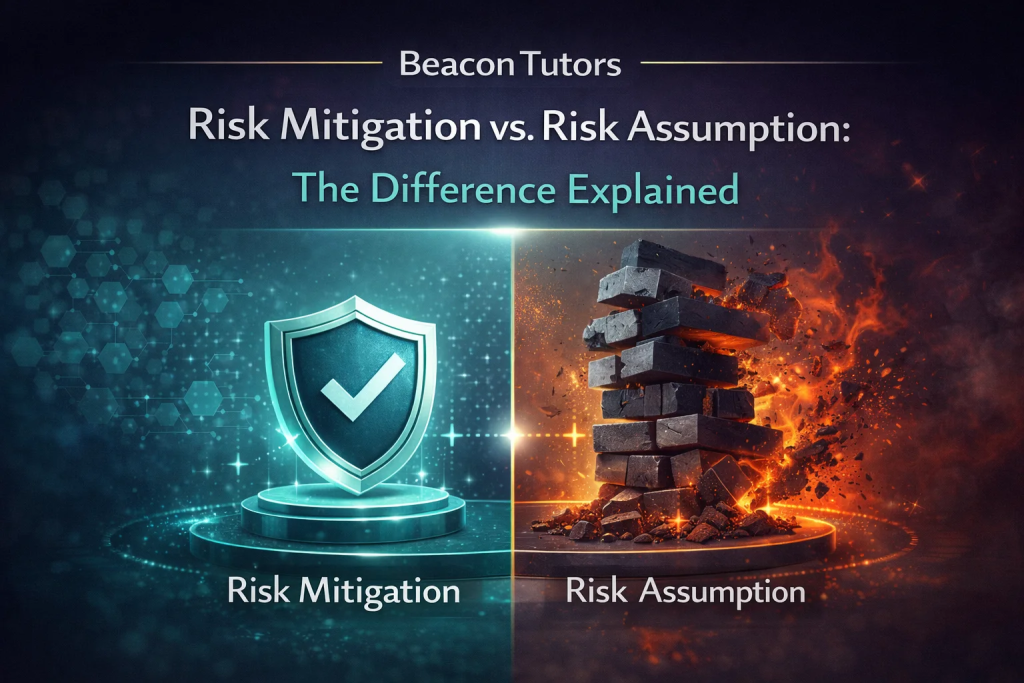
Risk Mitigation vs. Risk Assumption: The Difference Explained
How Beacon Tutors Defines Risk Within a Structured Marketplace Model
Every professional digital platform operates in an environment of risk. Risk does not imply instability. It reflects the reality that independent individuals interact within a shared infrastructure.
The important distinction is not whether risk exists, but how it is managed.
Beacon Tutors operates as a structured digital tutoring marketplace. Within this model, it is essential to understand the difference between risk mitigation and risk assumption. These two concepts are often confused, yet they represent fundamentally different governance approaches.
Understanding this difference clarifies how Beacon Tutors responsibly structures its policies and operational boundaries.
What Risk Assumption Means
Risk assumption implies accepting full responsibility for all possible outcomes, actions, and consequences arising within a system.
In a traditional employment or institutional model, an organization may assume broader liability because it exercises direct control over employees, processes, and operational decisions.
Supervision, command authority, and centralized oversight define that structure.
If Beacon Tutors were to assume full risk in that manner, it would require:
-
Direct supervision of every tutoring session
-
Control over individual teaching methods
-
Authority over student engagement levels
-
Continuous monitoring of academic performance
-
Centralized control over communication and instructional execution
That structure would fundamentally change Beacon Tutors from a marketplace into an employer or institutional authority.
Beacon Tutors does not operate under that model.
What Risk Mitigation Means
Risk mitigation, by contrast, involves identifying potential vulnerabilities and implementing structured systems to reduce exposure while maintaining operational realism.
Beacon Tutors mitigates risk through:
-
Clearly documented policies
-
Defined eligibility standards for tutors
-
Structured requirement collection processes
-
Transparent payment frameworks
-
Compliance guidelines
-
Dispute-resolution mechanisms
-
Defined liability boundaries
These measures reduce uncertainty without claiming unrealistic control over independent participants.
Risk mitigation is proactive governance. It strengthens the ecosystem without distorting its structure.
Real-World Marketplace Comparisons
The distinction between risk mitigation and risk assumption is consistent across global industries.
Freelance marketplaces verify profiles, provide escrow systems, and maintain review frameworks. They mitigate fraud and miscommunication risks, but they do not assume full responsibility for project outcomes.
Accommodation platforms implement identity checks, payment protections, and safety guidelines. They mitigate safety risks, but they do not assume liability for every subjective guest experience.
Ride-sharing platforms conduct driver screenings, maintain rating systems, and offer support channels. They mitigate operational risk, but they cannot assume responsibility for every external variable such as traffic conditions or passenger behavior.
Beacon Tutors operates within the same internationally recognized governance framework.
It mitigates risk. It does not absorb unlimited liability.
Why Risk Assumption Is Structurally Unrealistic in Tutoring
Academic outcomes depend on multiple independent factors:
-
The tutor’s professional expertise
-
The student’s consistency and effort
-
Communication alignment
-
Curriculum complexity
-
External examination conditions
-
Parental involvement
For Beacon Tutors to assume full risk over these variables, it would require control over human behavior and external academic systems.
Such control is neither realistic nor aligned with the marketplace model.
Risk assumption in this context would create unrealistic promises and unstable expectations.
Why Risk Mitigation Strengthens Trust
When Beacon Tutors defines its mitigation strategies clearly, it demonstrates:
-
Awareness of operational complexity
-
Commitment to fairness
-
Governance maturity
-
Transparency in responsibility allocation
Mitigation creates predictability. Predictability creates trust.
Unlimited guarantees may appear reassuring in theory, but structured mitigation builds sustainable confidence.
Beacon Tutors protects participants by defining boundaries rather than overstating control.
Governance Over Illusion
Risk assumption often creates an illusion of total control. Risk mitigation reflects professional realism.
Beacon Tutors does not claim to control every tutoring outcome or individual interaction. Instead, it builds structured systems that reduce risk exposure while maintaining independence and scalability.
This approach aligns with global marketplace standards and reinforces long-term credibility.
Shared Responsibility Within Risk Management
Within Beacon Tutors:
-
The platform mitigates systemic and procedural risk
-
Tutors manage instructional risk through professional conduct
-
Students manage performance risk through effort and engagement
This distribution ensures that responsibility remains realistic and balanced.
Risk cannot be eliminated in any human-centered system. It can only be structured and managed responsibly.
Conclusion
The difference between risk mitigation and risk assumption defines the maturity of a digital marketplace.
Beacon Tutors operates under a governance-driven model that mitigates risk through documented policies, defined boundaries, and structured oversight. It does not assume unlimited liability for independent actions beyond its operational scope.
Defined responsibility is not avoidance. It is professional clarity.
In modern digital marketplaces, sustainable trust is built not by absorbing unrealistic risk, but by managing it transparently and intelligently.