
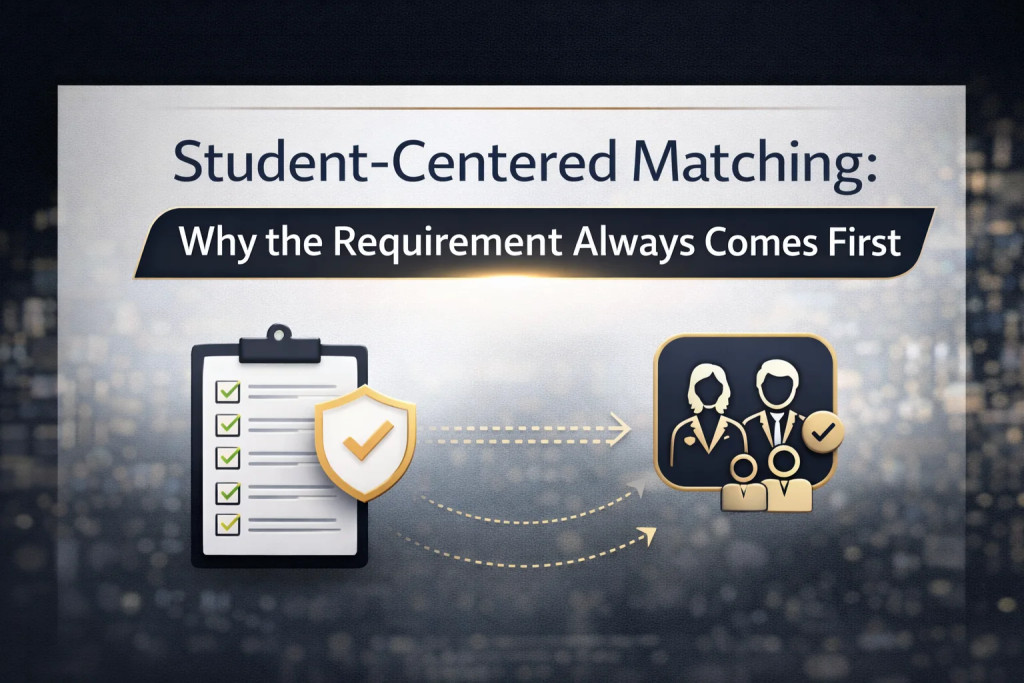
Student-Centered Matching: Why the Requirement Always Comes First
A Structural Framework from Beacon Tutors
Executive Overview
Beacon Tutors operates on a student-centered marketplace model. Within this structure, every academic engagement begins with a defined requirement. The requirement is not secondary. It is foundational.
At Beacon Tutors, matching logic is built around one principle: the student’s academic need determines alignment.
This approach ensures neutrality, efficiency, and relevance within the digital tutoring ecosystem.
The Student Requirement as the Starting Point
Every engagement within Beacon Tutors begins with a structured submission from a student or parent. This requirement defines:
Subject
Grade level
Curriculum
Schedule preference
Budget expectations
Geographic or time zone constraints
These variables establish the framework within which tutor visibility is determined.
Beacon Tutors does not begin with tutor selection. It begins with student need.
Why the Requirement Takes Priority
In a professional marketplace, prioritizing supply over demand creates inefficiency. If tutor profiles were pushed without regard to student-defined criteria, alignment would weaken.
Beacon Tutors avoids this by allowing the requirement to shape exposure.
When a student specifies advanced-level Chemistry within a defined time window and budget range, visibility is structured around those criteria.
This ensures that:
Students see relevant tutors
Tutors engage with aligned opportunities
Matching remains precise rather than random
Student-centered logic strengthens marketplace efficiency.
Real-World Marketplace Comparisons
The requirement-first approach used by Beacon Tutors mirrors global digital platforms.
On freelance marketplaces, projects define the search. Freelancers appear based on project relevance.
On accommodation platforms, guest-selected dates determine listing visibility.
On e-commerce platforms, search queries determine which products surface.
In each case, demand drives exposure.
Beacon Tutors follows this internationally recognized structure.
Protecting Fairness Through Requirement-Based Matching
A requirement-first model prevents:
Arbitrary visibility
Manual favoritism
Oversaturation of irrelevant profiles
Inefficient shortlisting
By prioritizing structured criteria, Beacon Tutors ensures neutrality.
Visibility becomes a function of compatibility rather than internal preference.
This protects both students and tutors.
The Role of Tutors Within a Requirement-Driven System
While the student requirement comes first, tutor alignment remains essential.
Tutors increase visibility by:
Accurately defining subject expertise
Updating availability
Maintaining clarity in grade-level specialization
Ensuring profile transparency
The more precisely a tutor profile reflects structured capability, the more effectively it aligns with student-defined requirements.
Beacon Tutors provides the framework. Alignment drives opportunity.
Avoiding Misinterpretation
When a tutor does not appear in a specific requirement, it should not be interpreted as exclusion or evaluation.
It reflects one of the following:
Subject mismatch
Availability conflict
Budget misalignment
Curriculum difference
Student-centered matching ensures that exposure is contextual, not universal.
Beacon Tutors maintains structural neutrality by allowing demand to determine alignment.
Conclusion
Student-centered matching defines how Beacon Tutors operates as a professional digital tutoring marketplace.
The requirement always comes first. Visibility follows compatibility. Fairness follows structure.
By prioritizing student-defined parameters, Beacon Tutors ensures relevant exposure, operational clarity, and sustainable marketplace integrity.
Student need shapes alignment. Structured governance protects fairness. Beacon Tutors operates at the intersection of both.